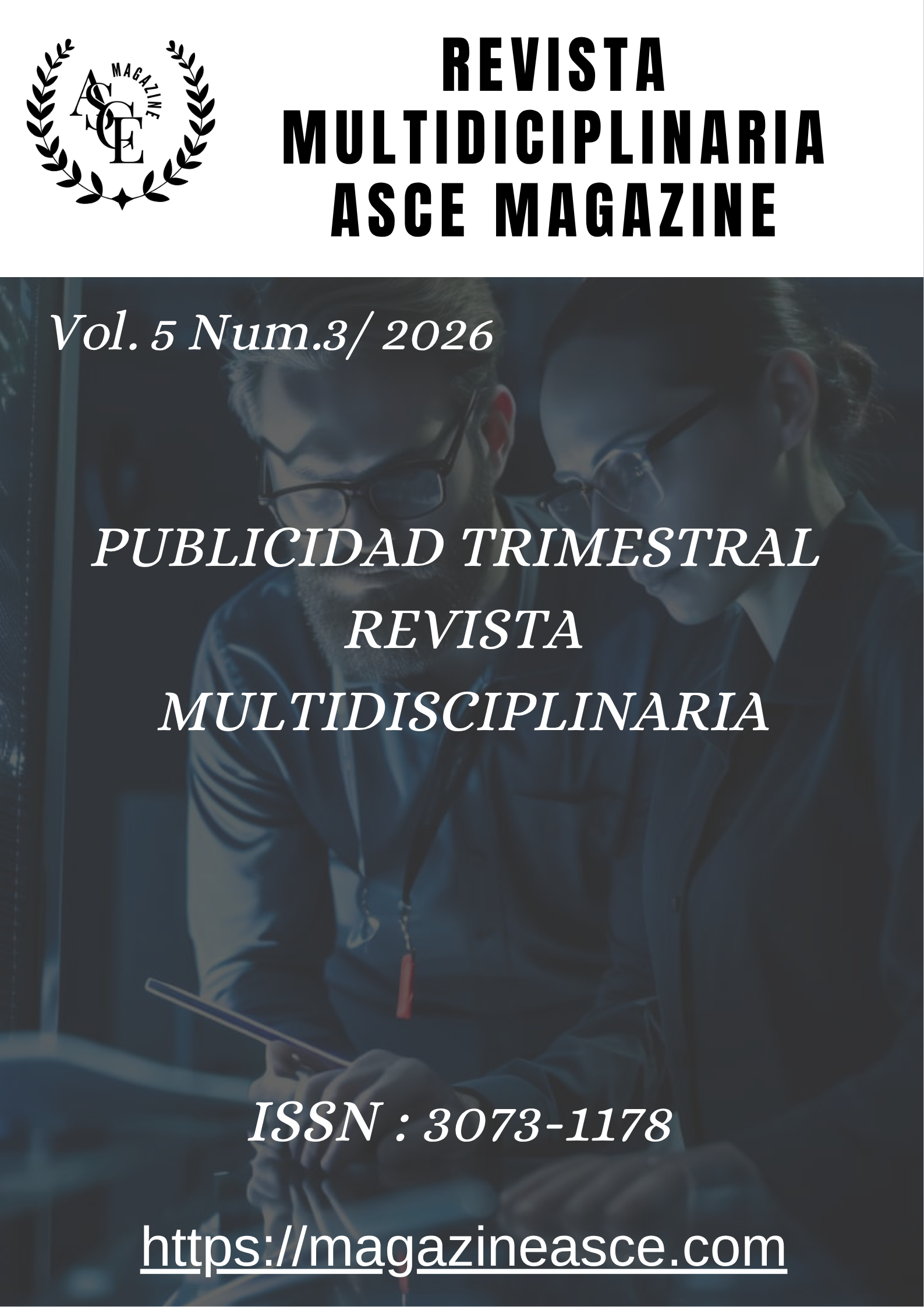
El impacto de la hiperconectividad digital en el estrés laboral y los riesgos psicosociales
DOI:
https://doi.org/10.70577/asce.v5i3.1009Palabras clave:
Estrés; Sobrecarga; Desconexión; Tecnologías; AgotamientoResumen
La hiperconectividad digital constituye uno de los principales desafíos en los entornos laborales actuales, derivado del uso constante de dispositivos y herramientas digitales que mantienen a los trabajadores conectados de forma permanente. Si bien estas tecnologías han aportado eficiencia, mejor comunicación y flexibilidad, también han generado nuevas exigencias que afectan la salud y el bienestar laboral, especialmente por la difuminación de los límites entre la vida personal y profesional al responder mensajes fuera del horario de trabajo.
El artículo analiza el impacto de esta hiperconectividad en el estrés laboral y los riesgos psicosociales, a través de un estudio cuantitativo descriptivo-correlacional aplicado a 60 trabajadores de los sectores de servicios, tecnología y educación superior. Se evaluaron factores como la disponibilidad permanente, la sobrecarga informativa, la interrupción del descanso y la dificultad para lograr una desconexión digital adecuada, identificando consecuencias como estrés, ansiedad, agotamiento emocional, fatiga y menor satisfacción laboral.
Los resultados muestran que el tecnoestrés (M = 3.36) predice de forma significativa los riesgos psicosociales (r = .61; p < .001; R² = .37), siendo la fatiga y la tecnoadicción las dimensiones de mayor influencia. Los trabajadores en teletrabajo presentaron los niveles más altos de tecnoestrés.
Estos hallazgos confirman que la exposición constante a las tecnologías de información y comunicación eleva significativamente los riesgos psicosociales, afectando el desempeño y la calidad de vida laboral. El estudio concluye destacando la necesidad de que las organizaciones implementen estrategias para promover el equilibrio vida-trabajo, fortalecer el bienestar psicológico y garantizar el derecho a la desconexión digital, como principal aporte a las políticas de prevención de riesgos laborales.
Descargas
Citas
Apolo, P. (25 de Abril de 2024). SCRIBD. Obtenido de https://es.scribd.com/document/726645402/3-6-PPT-Cuestionario-JCQ-1558206686
Diéguez, E., & Valdés, S. (2023). Validez de contenido de la escala RED-Tecnoestrés en el sector informático cubano. La Habana, 2023. ECIMED, 24.
Figueroa, C. A. (2026). Hiperconectividad: impactos en el bienestar integral y la productividad de los trabajadores. Consejo Colombiano de seguridad, 426(36-46), 11. doi:: https://doi.org/10.63434/30730171.460 DOI: https://doi.org/10.63434/30730171.460
González León, M. Á. (2022). Tecnoestrés y desconexión digital de las personas trabajadoras. RIULL, 41. doi:http://riull.ull.es/xmlui/handle/915/31612
Instituto Nacional de Seguridad y Salud en el Trabajo (INSST), O. M. (2025). ESTUDIO SOBRE LA HIPERCONECTIVIDAD Y LA SALUD MENTAL EN EL ÁMBITO LABORAL. Madrid.
Martín Rodríguez, O. (2021). El tecnoestrés como factor de riesgo para la seguridad y salud del trabajador. udiMundus, 20. doi:http://dx.doi.org/https://doi.org/10.1387/lan-harremanak.22239 DOI: https://doi.org/10.1387/lan-harremanak.22239
Meseguer-De Pedro, M., García-Guirao, N., & Soler-Sánchez, I. M. (2026). Hiperconectividad y derecho a la desconexión digital como riesgo psicosocial: la experiencia de la Universidad de Murcia. Revista Justicia y trabajo, 7. doi:https://doi.org/10.69592/2952-1955-EXTRA-MAYO-2026-ART-8 DOI: https://doi.org/10.69592/2952-1955-EXTRA-MAYO-2026-ART-8
PONS, F. T. (2020). La “desconexión digital” a lomos de la seguridad y salud en el trabajo. Lan Harremanak, 18. doi:https://orcid.org/0000-0002-1742-2037
Rincón Gómez, S. (2025). El exceso de trabajo: causas y consecuencias sobre el equilibrio vida-trabajo desde la prevención de riesgos laborales. UVa, 72. doi:https://uvadoc.uva.es/handle/10324/76800
Santilán, B. N. (2025). Riesgos psicosociales derivados de la hiperexigencia digital en entornos laborales: Impacto en el bienestar emocional y la salud mental de trabajadores ecuatorianos. Educaf5-Berit, 1(1), 27. doi:https://doi.org/10.5281/zenodo.18027863
Silvera, L. O. (2026). Estrés laboral y estrategias de afrontamiento en el trabajo remoto. Un acercamiento a la teoría. Revista Conexiones Científicas, Neuroarte y Bienestar, 2, 10. doi:https://editorial.mielsy.org/index.php/RCCNB/article/view/e0025
Descargas
Publicado
Cómo citar
Número
Sección
Licencia
Derechos de autor 2026 Nahomi Lissbeth Rodríguez Sánchez , Edison Marcelo Mancheno Padilla , Irene Teresa Bustillos Molina

Esta obra está bajo una licencia internacional Creative Commons Atribución-NoComercial-CompartirIgual 4.0.
Eres libre de:
- Compartir : copiar y redistribuir el material en cualquier medio o formato
- Adaptar : remezclar, transformar y desarrollar el material
- El licenciante no puede revocar estas libertades siempre y cuando usted cumpla con los términos de la licencia.
En los siguientes términos:
- Atribución : Debe otorgar el crédito correspondiente , proporcionar un enlace a la licencia e indicar si se realizaron cambios . Puede hacerlo de cualquier manera razonable, pero no de ninguna manera que sugiera que el licenciante lo respalda a usted o a su uso.
- No comercial : no puede utilizar el material con fines comerciales .
- CompartirIgual — Si remezcla, transforma o construye sobre el material, debe distribuir sus contribuciones bajo la misma licencia que el original.
- Sin restricciones adicionales : no puede aplicar términos legales ni medidas tecnológicas que restrinjan legalmente a otros hacer algo que la licencia permite.